Custom PTFE & Thermoplastic Machining Services
Not every plastic component can be produced with standard machining practices. Machined plastic parts such as PTFE valve seats and hydraulic seals often require extremely tight tolerances and consistent surface finishes to perform reliably in service.
Dover High-Performance Plastics (DHPP) specializes in close-tolerance thermoplastic machining, combining CNC turning and milling, in-house compression molding, and secondary finishing operations to produce custom machined plastic components to print.
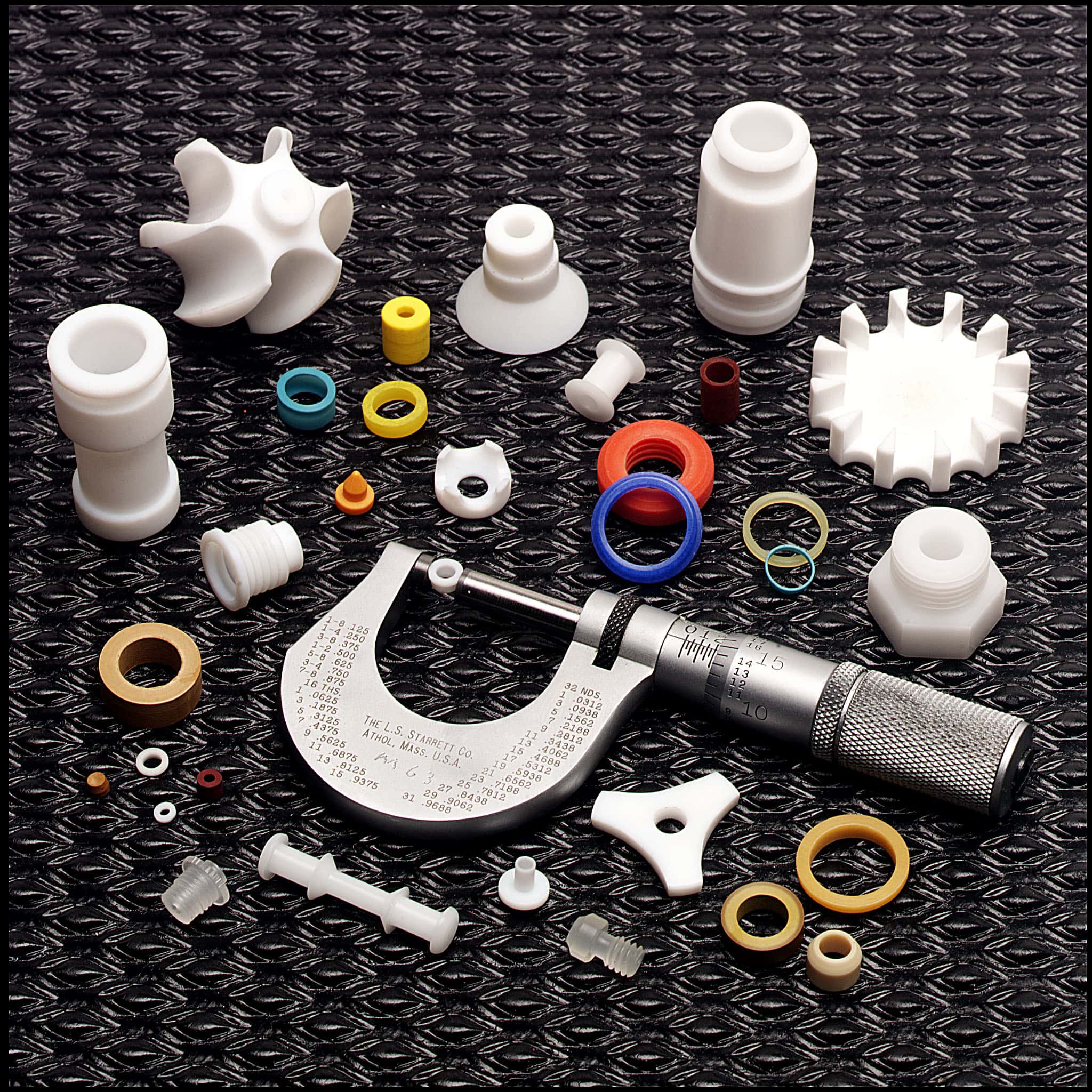
Advanced Production Machinery for
High-Performance Polymers
Different polymers and part geometries place different demands on the machining process. To support those requirements, we operate a broad range of CNC turning and milling equipment capable of producing close-tolerance thermoplastic components at scale.
CNC Swiss Machining for Intricate, Small-Diameter Parts
Swiss-style CNC machining uses a guide bushing directly behind the cutting zone. This setup supports the workpiece at the point of cut instead of relying on a cantilevered setup from a chuck. That added stability is critical when machining slender rods or small-diameter components in soft materials such as PTFE and UHMW.
This approach helps maintain tighter diameter tolerances, better concentricity, and smoother surface finishes on parts under an inch in diameter. For design engineers who need repeatable geometry on small polymer bushings, seal rings, or threaded inserts, Swiss machining typically offers the most reliable means of achieving consistent dimensional conformance.
Automated Screw Machining & Lathe Chuckers for High-Volume Production
Our automatic screw machines and lathe chuckers with sub-spindle and driven-tool capabilities handle high-volume turned parts with precision repeatability. Sub-spindle configurations allow backworking in the same cycle, reducing setups and re-chucking errors while shortening lead times for parts that need machining on both ends.
This matters for pump and valve component engineers who need hundreds or thousands of identical sealing elements per release. Dimensional consistency is maintained across a production run because the machine controls each cycle, a significant advantage over manual setups where operator variability accumulates.
Key production advantages:
- Multiple cutting operations within a single cycle
-
Driven tool capability for cross-drilled holes, slots, and flats without secondary setups
-
Consistent cycle times that support predictable delivery schedules
Multi-Axis Vertical and Horizontal CNC Milling
Our 4-axis CNC milling centers handle components up to 30 inches of travel. Vertical and horizontal configurations with power-feed capabilities cover everything from large flat plates to complex 3D profiles in engineering thermoplastics.
Hydraulic and food processing applications frequently call for custom shapes, such as manifold blocks, wear pads, or guide plates, that go beyond what turning can produce. The milling floor handles those geometries while holding tight positional tolerances across features that must align precisely in assembly.


Overcoming Material Challenges in
High-Performance Plastic Machining
Machining PTFE, PEEK, Nylon, and similar thermoplastics is not simply “softer metal machining.” The properties that make these polymers effective in service also make them challenging to machine.
Managing Thermal Expansion and Dissipation in Thermoplastics
Thermoplastics expand far more than steel and dissipate heat less effectively. Heat buildup during machining can soften the material, causing dimensional variation as the part cools.
In PTFE and Teflon® compound machining, low thermal conductivity causes heat to remain concentrated at the tool-chip interface. If not controlled, heat buildup can cause smeared surfaces, dimensional drift, and inspection failures.
We control this through:
- Sharp, high-positive-rake tooling that minimizes heat generation at the cut
- Appropriate feed rates and depth-of-cut sequences to prevent thermal buildup across long cuts
- Built-in stabilization time before final inspection for temperature-sensitive tolerances

Tooling Clearances and Feed Rates to Prevent Creep and Distortion
PTFE and filled PTFE compounds are viscoelastic. Under cutting pressure, the material deforms elastically and springs back after the tool passes. This “spring back” causes bores to come out undersized and ODs to finish oversize relative to the tool path.
Managing this requires intentional tooling clearances and controlled feed rates that minimize radial force. It also means measuring in-process with gauging that accounts for temperature, not just reading the CNC coordinate position.
Our quality assurance process leverages Statistical Process Control (SPC) to embed dimensional verification throughout the machining process. This catches material behavior issues early, before a full batch of parts has been run.

Value-Added Secondary Operations
Tight-tolerance polymer components often need more than turning and milling. Edge condition and surface finish can be just as critical as dimensional conformance, especially in medical, food-grade, and fluid sealing applications.
Cryogenic Part Deburring for Flawless Edge Radii
Conventional deburring methods struggle with soft thermoplastics. Aggressive methods distort the part. Gentle methods leave burrs or feathered edges on internal features that a tool can’t easily reach.
Cryogenic deburring solves this by chilling parts to temperatures where the polymer becomes brittle. The thin flash and burrs that form at parting lines and exit holes break away cleanly at those temperatures, while the part body remains unaffected. The result is a controlled, consistent edge condition without dimensional impact on the finished geometry.
For custom valve seats and sealing components, cryogenic deburring helps eliminate leakage paths caused by ragged edges.

Precision Lapping, Etching, and Specialty Surface Finishes
Surface finish affects more than appearance. In sealing and bearing applications, Ra directly influences leak rate, friction, and part life.
Our secondary finishing services include:
-
Precision lapping: Produces flat sealing faces that mate without high spots.
-
Chemical etching: Improves PTFE surface bondability for assemblies that require adhesive joining.
-
Specialty surface finishes: Achieve specific Ra targets defined in customer drawings, ranging from fine-turned finishes to textures required for seal mating faces.
These operations are performed in-house, which keeps the supply chain short and reduces the handling risk that comes with shipping semi-finished parts to an outside vendor.

Blending Disciplines:
Compression Molding + Precision Machining
One of the more overlooked capabilities in close-tolerance thermoplastic machining is the ability to combine shape-making and precision finishing under one roof. Most machine shops work from rod, tube, or plate stock. Our process can begin one step earlier.
Maximizing Yield and Minimizing Scrap Costs
Automatic compression molding allows us to press a near-net-shape blank directly from PTFE or filled compound powder. The blank arrives at the machining floor close to its final cross-section. This reduces the amount of material removed during machining.
For large-diameter components, this matters economically. PTFE rod stock in large diameters is expensive. Machining away most of that material to reach a thin-wall ring or custom profile wastes both material and cycle time. A compression-molded preform eliminates most of that waste before a single cutting tool is engaged.

Achieving Critical Tolerances on Custom Engineered Shapes
Some part geometries simply cannot be efficiently produced from standard stock. Heavy-wall tubes, eccentric profiles, custom cross-sections—these either don’t exist in catalog form or require a starting blank that would be cost-prohibitive to machine from solid.
In-house compression molding creates a near-net-shape blank, while precision CNC machining brings the part to final tolerance. Critical dimensions such as bore diameter, flatness, wall thickness, and concentricity are achieved through machining, not molding alone.
This workflow is particularly relevant for hydraulic packing sets, large pump bushings, and custom valve seats, where both geometry complexity and tight tolerances must be satisfied simultaneously.

Specify Your Custom Polymer
Component With DHPP
Machining advanced polymers requires an understanding of how plastics respond differently to cutting forces compared to metals. From managing thermal expansion at the cutting zone to cryogenic deburring and compression-molded preforms, every step in DHPP’s process is matched to how high-performance polymers actually behave in service. PTFE machining and close-tolerance thermoplastic machining are disciplines that reward process depth.
If you have a custom polymer component that needs to meet tight print tolerances, contact us to discuss your specifications. We are equipped to handle the full range of your component production needs.
